
The cost of carbon removal doesn’t just depend on chemistry or scaling, it depends on who finances the infrastructure.
Last time, we explored How Carbon Removal Gets Financed. This week, we’ll talk about who does that financing and what it means for the cost of carbon removal.
Financing sets the boundary conditions for scale. A project backed by private investors paying high interest rates has a very different cost structure than one financed with public credit or sovereign guarantees. Those differences – often just a few percentage points in the cost of capital – can double or triple what society ultimately pays.
What Drives CDR Cost Curves
Learning rates show how costs tend to fall as projects scale and technologies mature. In this context, there are both visible and hidden levers.
Visible levers are the ones most people recognize: the capital costs of building a plant (CapEx) and the operating costs of running it (OpEx; energy, labor, materials). These are the focus of most cost curves and techno-economic models.
But hidden levers move the cost just as much – even if they’re rarely discussed. They operate in the background, shaping what’s possible before a single ton is removed. The most important of these is the cost of capital, or the cost of money itself.
Every ton of carbon removed carries an invisible price tag: the interest rate on someone else’s money. Whether it’s a first-of-a-kind facility or a multi-site removal network, someone provides capital and expects a return. Those expectations – what investors demand back for taking risk – ripple through the entire cost structure.
The Cost of Money
How a project is financed determines how expensive it is to build and run over time.
The cost of capital is basically the price of using other people’s money. Banks charge interest when they lend; investors expect a return when they buy in. Together, those expectations form what’s called the “weighted average cost of capital,” or WACC. The higher the WACC, the higher the hurdle a project must clear to be considered viable – and the more expensive each ton of carbon removal becomes.
When the cost of money is high, the total cost of a project climbs too. The effect is especially strong for anything that requires big upfront spending (often capital-heavy projects). If the money you borrow costs 10 % a year instead of 3 %, you’ll keep paying extra on every dollar you invested – likely for decades. Even a small change in that rate can make the overall price tag much higher.
If this still feels abstract, think about a mortgage or student loan. A few percentage points in interest can mean paying thousands – or even hundreds of thousands – more over time. For carbon removal, the same principle scales to billions.
That’s why the cost of money doesn’t just decide whether a project can get built; it influences what gets built, where, and by whom. That brings us to the real question – whose money are we using?
How Big is the Gap?
Not all money costs the same. Private investors and public institutions play by very different rules – and that gap shapes what carbon removal will cost society. Early carbon removal projects are financed like startups or first-of-a-kind infrastructure – through venture, project finance, and infrastructure funds that demand high returns for taking risk.
So, let’s take an example. Imagine building a 1 MtCO₂/year carbon removal facility that costs about $1.5 billion in capital and has an operational cost of $90 per ton. The plant runs for 25 years.
Below is a simplified table of how different financing structures influence the total cost. The assumptions are illustrative, but the pattern is real: lower-cost capital reduces what the world pays per ton of carbon removed.
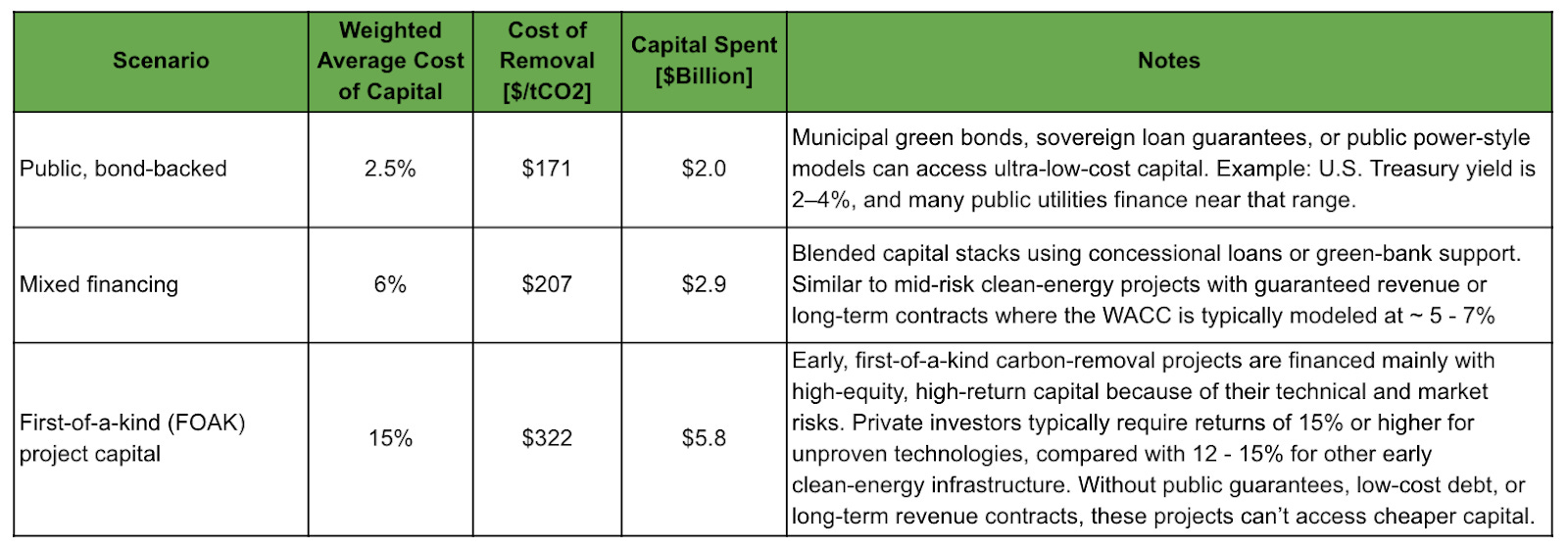
The table shows the same project under three financing structures – from public to private – and how small differences in the cost of capital translate into very large differences in both total project spending and levelized cost per ton.
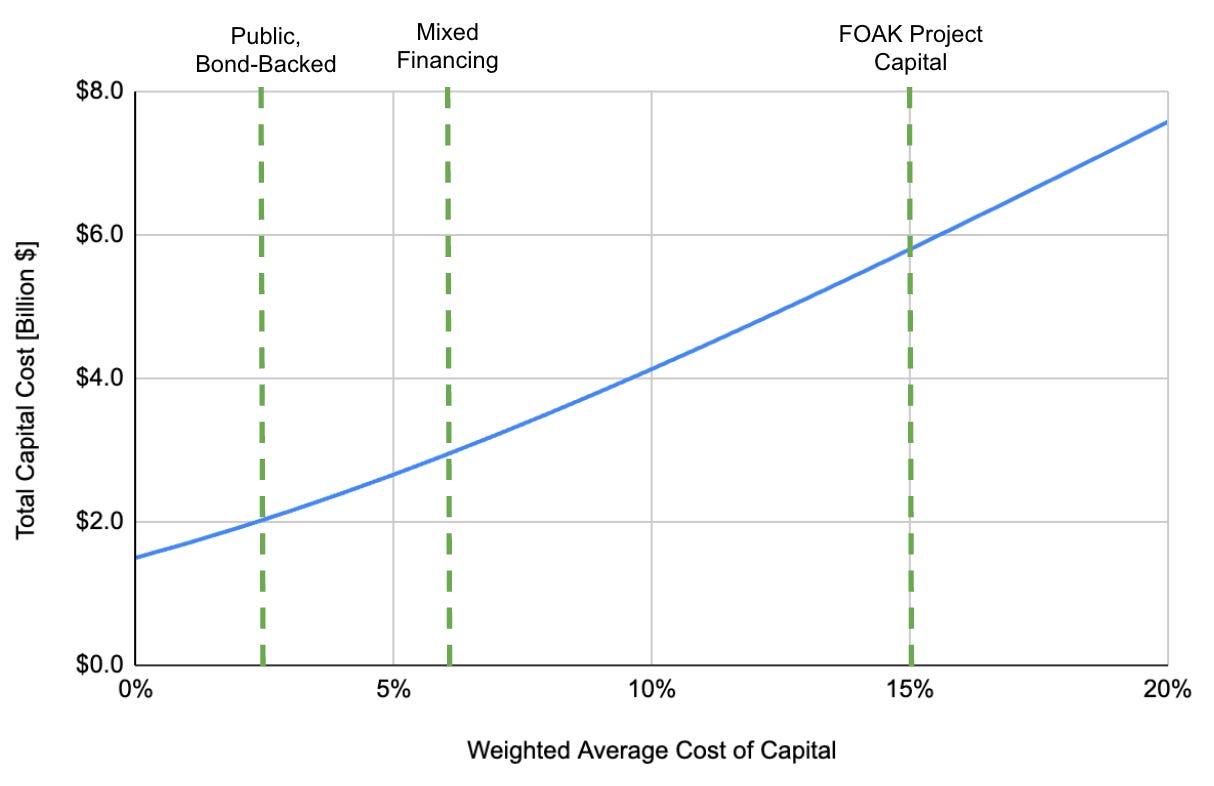
While the table gives a snapshot of three financing cases, the relationship between financing cost and total project cost is continuous. The two charts below show how the total project cost and the levelized cost of removal rise as the WACC increases. Together, they highlight just how powerful this ‘hidden lever’ really is.
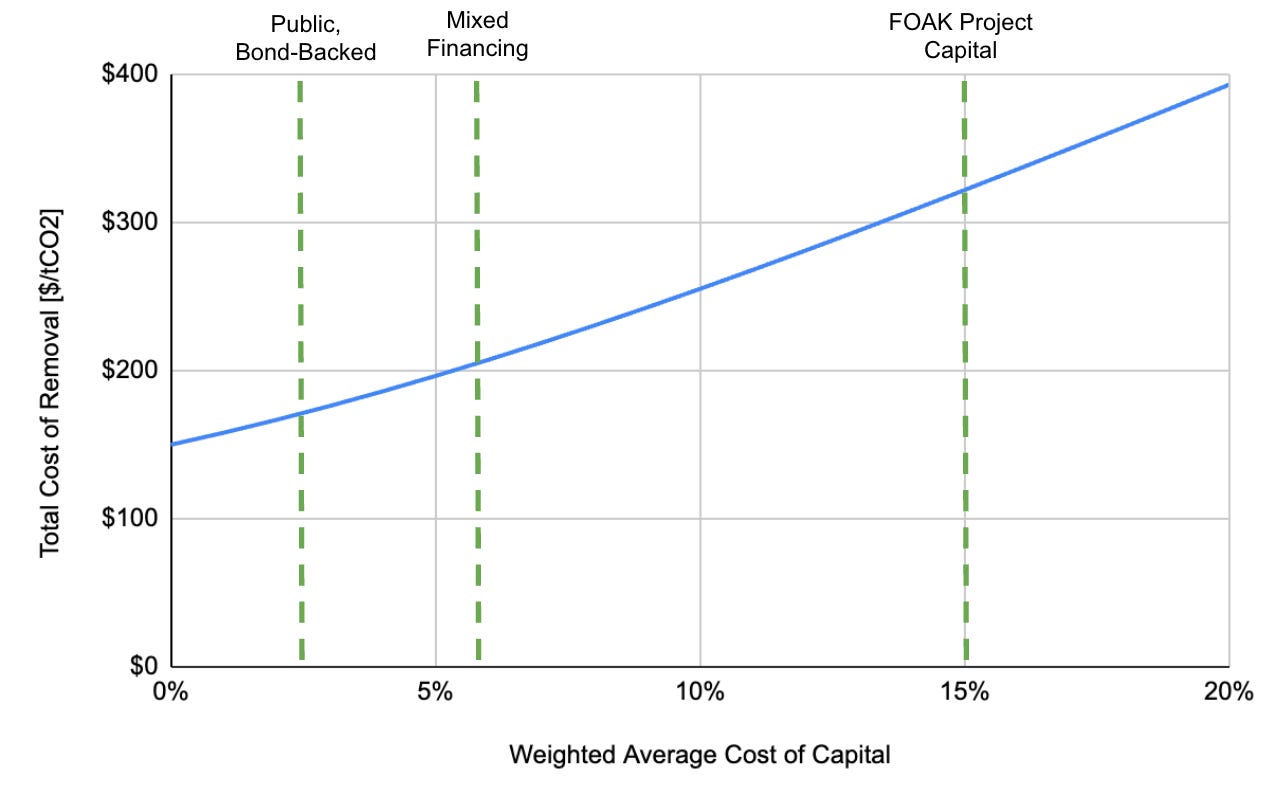
If you’re interested in learning more, check out the IEA’s page on The Cost of Capital in Clean Energy Transitions – a great breakdown of how financing costs shape energy technologies across different markets and stages of maturity. It also includes a clear explanation of the WACC formula for those who want to dive deeper.
These financial differences aren’t theoretical: They define who can build, at what pace, and on what terms. And that makes financing a policy question as much as an economic one.
Rethinking CDR Cost as Policy
The same technology, financed three different ways, produces a two- to three-fold difference in cost – without changing a single piece of the technology. So when we talk about the cost of carbon removal, we have to ask: cost to whom?
Carbon removal is, at its core, a public good. It delivers shared climate benefit without direct private return. That means how we finance it determines not just cost, but who carries it.
Cost isn’t fixed in nature. It reflects a set of financial assumptions – who owns the asset, what returns investors demand, and how risk is distributed. If we assume that private markets will finance, own, and operate carbon removal infrastructure, we’re also assuming a high cost of capital baked into every ton removed.
Public or publicly supported approaches, especially for high-durability, climate-relevant systems, can look very different. They:
Lower the cost to society by accessing cheaper public credit;
De-risk early movers through guarantees and blended finance;
Create a cheaper, more durable public option that others can build from.
Together, these tools reshape the economics of scale – not by changing the technology, but by changing the terms of money itself.
In practice, no single capital source can carry this alone. A resilient system blends both – each with strengths and trade-offs. Public-private approaches might include:
Public guarantees and concessional loans that anchor early projects;
Publicly owned, supported, or guaranteed entities that can borrow cheaply;
Low-cost capital vehicles designed for long-term climate benefit.
Climate-Relevant CDR Requires Public Finance
The climate can’t afford capital that’s either too costly or too slow. Private investors optimize for return and speed; public finance optimizes for stability and scale. The gap between those worlds – and how we bridge it – will determine whether we reach gigaton impact or stall out at pilot plants.
We’ve done this before. When societies needed to electrify, irrigate, or connect, they didn’t wait for private markets to make it profitable – they built it together.
Rural electrification used public credit to light up towns that private utilities ignored (see the Rural Electrification Act).
Clean water access came from public works and low-interest loans (such as the Clean Water State Revolving Fund).
National highways and the internet were built through public investment, then opened to private participation (for example, the National Interstate and Defense Highways Act).
Carbon removal deserves the same ambition. We need financing systems that move fast enough to meet climate deadlines, keep costs low enough to scale, and remain accountable to public outcomes, ensuring carbon removal serves society, not just shareholders.
Conclusion
Financing isn’t just about moving money – it’s about shaping the world we build. How we fund carbon removal will decide not only what scales, but who it serves, who benefits, and how durable it becomes.
Technology and markets can start the work. Policy, purpose, and public design will determine whether it lasts.
Next time, we’ll look at the policy tools that might make this real: the levers governments can pull to move capital, create markets, and close the gap.
❓What mix of public and private tools do you think could make this shift real — and who should take the first step?