
Before we jump in, I want to thank everyone who shared the Carbon Removal Jobs post last week! I hope it’s reaching the people who need it most. The response was a reminder of how many people are trying to make sense of this field – not just what to build, but how to make it real.
Everyone wants carbon removal to scale. But learning curves don’t bend without money, and right now, that money isn’t moving fast enough or far enough.
Last time, we looked at Why Carbon Removal Must Learn Fast. This week, we’re looking at how it gets financed: what financing actually means, how it happens in practice, and why it’s so often a bottleneck.
Learning curves only work if carbon removal gets funded: funded for R&D, for deployment, for everything in between. This post breaks down how projects get funded (or rather, financed) to push CDR to scale, and why the way capital flows shapes which technologies succeed.
Quick aside: What’s the difference between being funded and financed? Funding can come from many places (for example, grants, philanthropy, buyers, or venture capital). But most future CDR projects will likely rely on project finance – raising capital that must be repaid from the project’s own future cash flows. There’s limited precedent today, but as plants scale, this model is expected to become the norm: The same approach that underpins wind farms, solar plants, and wastewater treatment infrastructure. And that has big implications for how carbon removal technologies evolve.
Mechanisms for Financing
Financing sounds abstract, but in practice it’s just the different ways money enters a project: who provides it, what they expect in return, and how much risk they’re willing to carry.
For carbon removal, we expect most funding to flow through a handful of well-worn paths borrowed from infrastructure and clean energy. The table below summarizes the main mechanisms and how each one works in practice. Together, they define who holds risk and who gets paid: The core logic that decides which projects actually move forward.
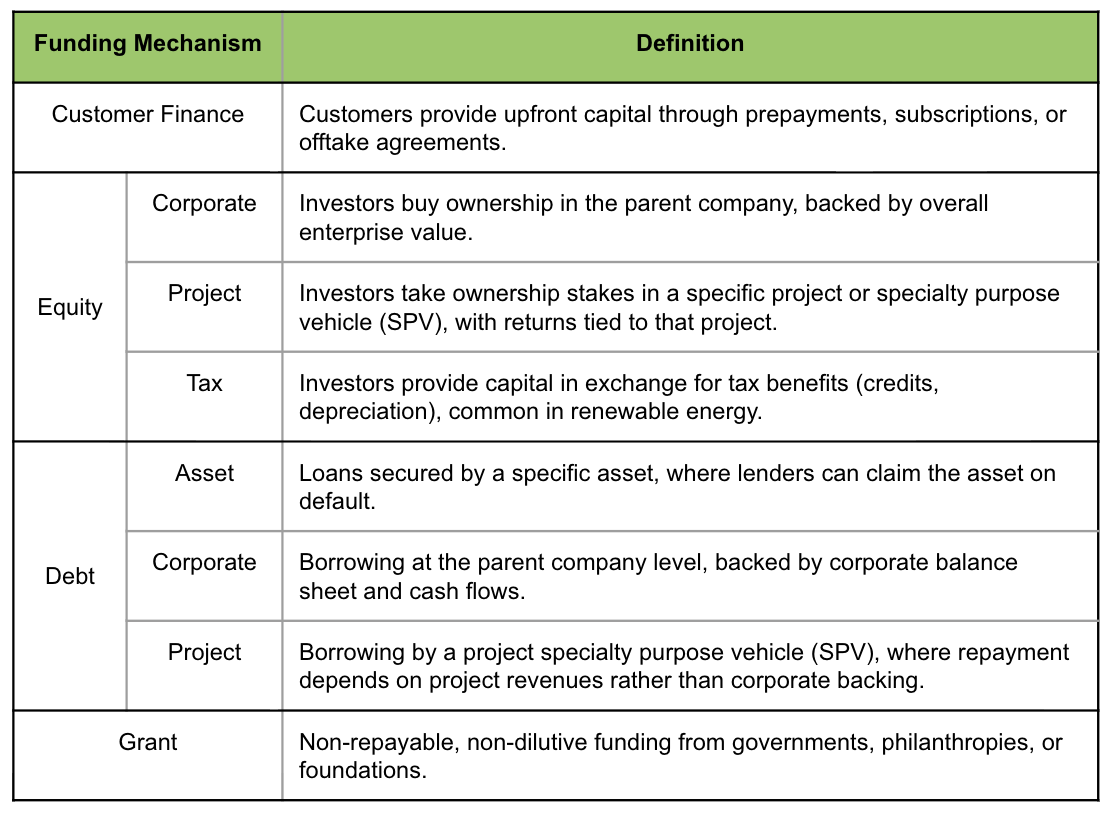
No single mechanism is enough on its own. Early-stage work often relies on grants and equity, while larger plants typically blend multiple layers – offtake pre-payments, concessional loans, tax incentives, and project debt. Each source carries different expectations for control, repayment, and return.
If you’re curious about how this looks today, the Office of Clean Energy Demonstrations has a useful breakdown of capital sources for early- and late-stage CCUS projects.
Once you understand the tools, the next question becomes how and when they’re actually deployed. That brings us to project lifecycles: the structured process that guides when money moves, how decisions are made, and what risks need to be retired at each stage.
The Lifecycle of a Project
Once the capital stack is in place, the next question is when it’s deployed. Most large carbon removal projects follow a structured development pathway adapted from heavy industry, known as the Front-End Loading (FEL) process.
Each stage is designed to sharpen certainty – technical, financial, and operational – while reducing the risk of expensive surprises later. Every major investment decision builds on the last, culminating in the Final Investment Decision (FID): the inflection point when a project shifts from concept to commitment. From that moment on, lenders expect repayment, and the project moves from plans to steel and concrete.
After FID, projects move through detailed engineering, procurement, and construction, where plans become physical assets, and finally into startup and operations, where systems are commissioned, performance is validated, and long-term reliability is proven. The language people use to describe these stages varies across organizations, but the underlying logic is similar. The diagram below is kept at a high level to illustrate the full lifecycle from concept to operation.
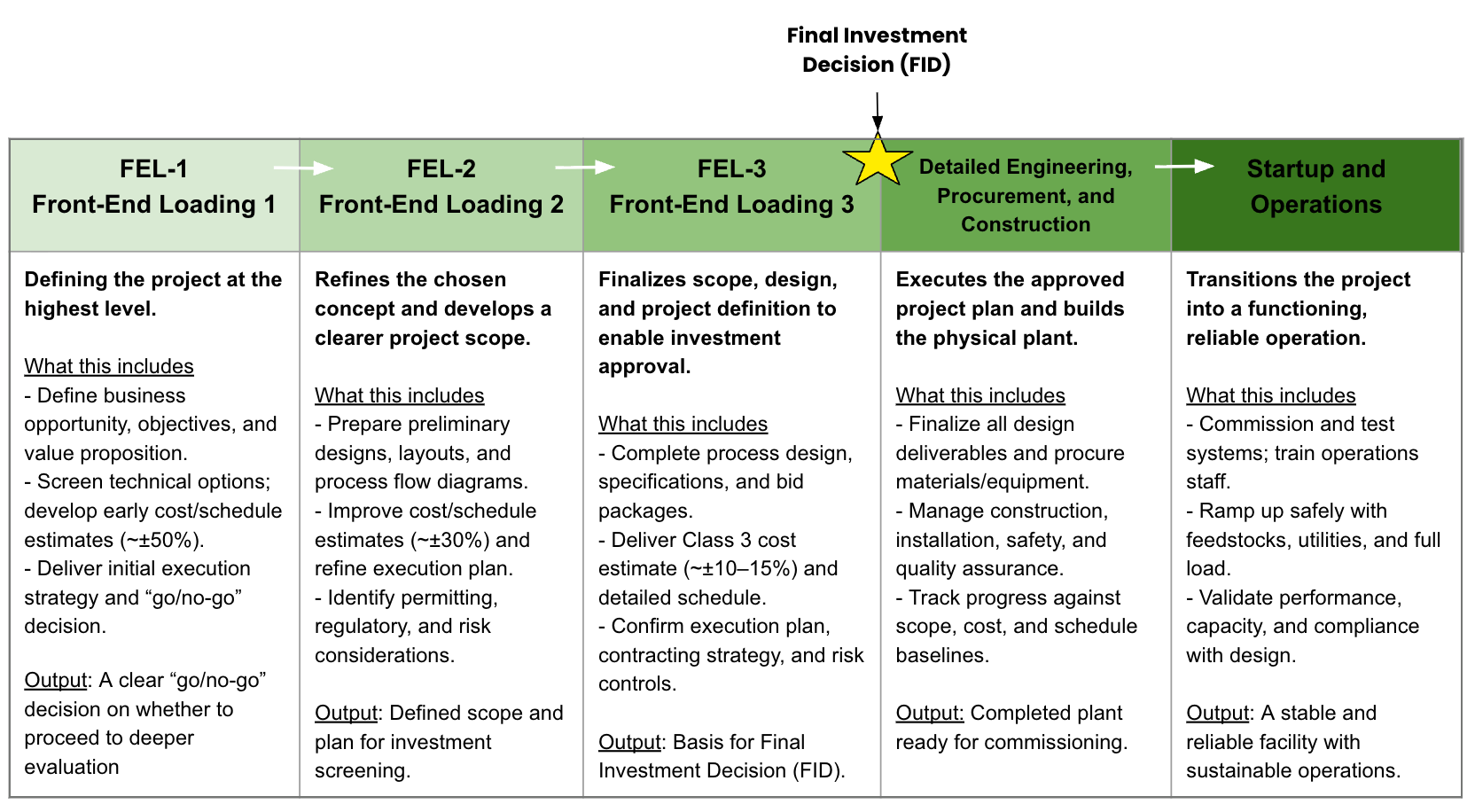
The further a project advances, the more expensive mistakes become, which is why early clarity on design, costs, and risks is so critical. That clarity, in turn, depends on a set of enabling factors that determine whether a project can reach FID at all.
Enabling Factors (& How it Impacts Learning Rates)
The further a project advances, the more capital it requires, and the higher the stakes if something goes wrong. To reach the Final Investment Decision (FID), a project must satisfy a handful of financial and technical conditions that investors use to judge whether it’s ‘financeable.’ These conditions are what ultimately determine which projects move forward and how quickly the field learns.
What impacts FID?
Revenue certainty: Binding offtake agreements or other forms of contracted financial backing. Ideally, a large, credible buyer helps mitigate risk.
Cost visibility: Clear line of sight to key operating costs, especially things like energy given how competitive the current market is.
Technical maturity: No (or limited) unresolved technology risks at commercial scale. Pilots or first-of-a-kind (FOAK) systems should have demonstrated safe, stable operation.
Economic viability: A project that shows returns meeting investor thresholds.
When these pieces align, financing moves from hypothetical to real. But when one is missing capital can stall, and learning slows.
Several enabling conditions accelerate this cycle:
Early demand signals: Government procurement, advance market commitments (AMCs), buyers’ clubs, and long-term offtakes. These pull forward private investment.
Finance levers: Grants, concessional loans, guarantees, or credit enhancements. These lower the cost of capital and make early projects bankable.
Measurement, reporting, and verification (MRV): credible quantification reduces revenue risk and enables financing against verified tons.
Policy alignment: Tax credits and public procurement act as revenue enhancers, while permitting and siting remain major sources of delay.
Taken together, these elements define a project’s bankability, or the degree to which investors view its revenues and risks as predictable. Bankability isn’t a single metric, it’s a moving target that improves as uncertainty shrinks. And, because learning curves depend on projects getting built, financing and bankability directly shape how fast the entire field can learn.
One (Potentially) Hot Take
A few reflections that might ruffle some feathers but feel worth saying out loud: the deeper issue isn’t a lack of money, it’s misaligned expectations. We’re asking markets to price a public good, then acting surprised when they don’t. Carbon removal doesn’t produce an intrinsic commodity; its value only exists because we decide it matters. That makes traditional financing logic – which chases returns, not impact – a poor fit.
Until incentives align around climate outcomes instead of short-term returns, financing will keep rewarding projects that look profitable on paper, not the ones that most effectively remove carbon and mitigate the most catastrophic effects of climate change. That tension sits at the heart of why CDR financing remains so challenging, and why public and blended finance will likely have to lead.
This tension between what the market rewards and what the climate needs runs through nearly every conversation about carbon removal finance. It’s not just a question of how much money there is, but whose money it is and what it costs to borrow. Private capital can move quickly, but it’s expensive. Public and publicly-backed capital moves slower, but it’s cheaper, and that difference shapes everything from project design to the price per ton.
Next week, we’ll dig into that hidden lever: the cost of money. We’ll look at how ownership and financing structures (private versus public) can significantly swing the total cost of carbon removal, and what that means for building a system that’s fast, fair, and affordable.
👇 Curious to hear from those who’ve worked on FOAK or infrastructure-scale projects: What made financing hardest in practice?
Great perspectives on getting to FID - early demand signals, finance levers to lower cost of capital, MRV, and incentives to pull forward private investment map are key in making projects bankable. Beyond carbon removals, we'll need to apply these levers to finance FOAK infrastructure across clean commodities
Exactly the problem GlobalCarbonReward.org intends to solve. At scale.